
Developing Systems Architecture
Connected Systems.
SPHIROSYSTEM
Connected Systems.
Continued Capability.
Work Continues Regardless!
SPHIROSYSTEM is IIC's developing architecture for connecting independently useful systems into a larger environment capable of observing real conditions, preserving evidence, using appropriate local resources, and maintaining useful capability as conditions change.
Augment. Never replace.
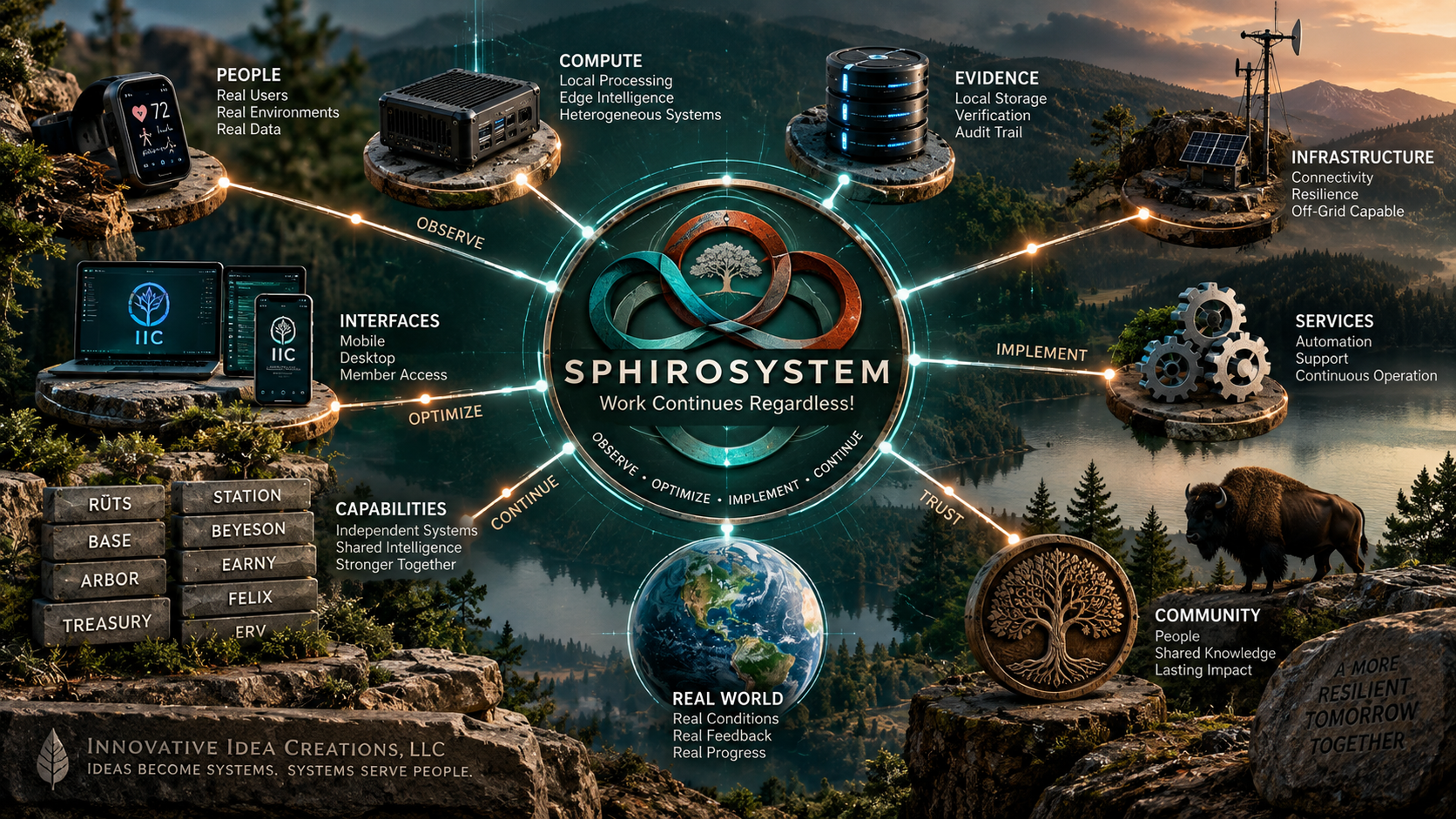
Independent capability.
Stronger together.
SPHIROSYSTEM does not begin with the assumption that every device, application, or service should become one centralized system.
Its direction is the opposite: preserve useful independent capability, establish trustworthy ways for systems to observe and communicate, and allow resources to cooperate when doing so improves the work being performed.
A wearable should remain useful as a wearable. A compute platform should remain useful as compute. A mobile interface should remain useful as an interface. Infrastructure should continue performing its own purpose.
SPHIROSYSTEM explores what becomes possible when those capabilities can also recognize and support one another.
Observe what is real.
Observe. Optimize.
Implement. Continue.
IIC uses the OOIC cycle as a practical method for moving from observation to implementation without treating the first answer as the final answer.
Observe
Understand what is actually happening before deciding what should change.
Optimize
Refine the approach using evidence, constraints, available resources, and what has already been learned.
Implement
Build the solution, put it into operation, and verify its behavior in the real world.
Continue
Preserve what worked, document what was learned, and begin the next observation cycle.
System Landscape
Different roles.
Different roles.
Shared environment.
SPHIROSYSTEM is being developed around specialized components rather than a single device expected to perform every task.
Observation can occur close to real-world activity. Compute can occur where appropriate resources are available. Interfaces can remain close to the person using them. Evidence can be preserved without requiring every component to independently reproduce every other capability.
The long-term objective is an environment in which useful capabilities can cooperate while remaining independently attributable and understandable.
Architectural Principle
Connect capability.
Connect capability.
Do not erase identity.
A connected system should still be able to explain where an observation originated, what resource performed work, what was verified, and what remains uncertain.
Different responsibilities.
One connected ecosystem.
SPHIROSYSTEM is not a collection of identical components. Vessels, interfaces, coordination services, evidence systems, compute resources, and research functions each retain distinct responsibilities while participating in a common architecture.
01
User & Interface
Keep useful system information and interaction close to the person participating.
02
Vessels
Devices designed to steward data and augment user participation within defined operating bounds.
03
Firmware & Evidence
Establish trustworthy observations close to where real-world information originates.
04
Coordination & Preservation
Move useful information without losing where it came from or what happened along the way.
05
Compute & Infrastructure
Use locally controlled resources where they are appropriate to the work.
06
S.E.R.D.
SPHIROSYSTEM Electrical Research Developments
Electrical R&D across the ecosystem.
S.E.R.D. develops electrical and electronic capabilities intended to augment multiple areas of SPHIROSYSTEM rather than belonging to a single vessel or service.
Sensor integration, power systems, observability, communications hardware, custom electronics, interfaces, and future electrical developments can originate here and support the ecosystem wherever they are useful.
07
Connected Environments
Connection does not imply containment.
Independent capability. Stronger together.
Know where information came from.
SPHIROSYSTEM research places emphasis on attributable observation. A useful system should distinguish between what was directly observed, what was calculated, what was reported by another component, and what remains an interpretation.
That distinction becomes increasingly important as systems become more connected. More information is not automatically better information.
Observe what is real. Verify locally. Report honestly. Preserve evidence.
Continuity
Capability should survive change.
Networks fail. Power conditions change. Compute resources become unavailable. Devices move. Sensors disagree. Software changes. People change what they need.
SPHIROSYSTEM treats those conditions as engineering realities rather than exceptions.
The developing architecture explores how useful capability can recognize available resources, preserve evidence, communicate changing conditions, and continue useful work without pretending every component or connection will always be available.
Observe.
Recognize.
Verify.
Adapt.
Preserve.
Continue.
Systems serve people.
SPHIROSYSTEM is not being developed around the goal of removing human judgment from meaningful decisions.
Its direction is to make relevant observations, evidence, computational capability, and system state more useful to the people performing the work.
Automation and local intelligence can assist with observation, qualification, coordination, and repetitive work while preserving human authority where human judgment belongs.
Augment. Never replace.
Build it. Test it.
Observe what happens.
SPHIROSYSTEM is being developed through implementation, observation, and refinement rather than specification alone.
Individual capabilities are built and tested in the environments where they are intended to operate. What happens in the real world becomes evidence for what should be preserved, changed, expanded, or reconsidered.
A working implementation is not treated as the end of development. It creates another opportunity to observe the system, understand its behavior, and improve what comes next.
Improve it. Continue.