Body Contact
Optical evidence contributes an observation that the wearable is physically being worn.
Ideas Become Systems
Rūts
Grow your Proofolio with solid Rūts.
Rūts is a wearable liveness and observation platform in development by Innovative Idea Creations. It observes independent evidence surrounding real-world human participation while activity is happening.
Observe what is real. Qualify locally. Report honestly. Preserve evidence. Continue.
Digital content is increasingly easy to create, modify, synthesize, and generate. A photograph, document, location claim, or timestamp by itself may say increasingly little about how something actually came into existence.
Rūts approaches that problem from the physical side. Rather than attempting to determine afterward whether something looks authentic, Rūts is being developed to observe independent evidence while real activity is occurring.
What independent observations accompanied its creation?
A sensor reading is not treated as proof merely because a sensor produced it.
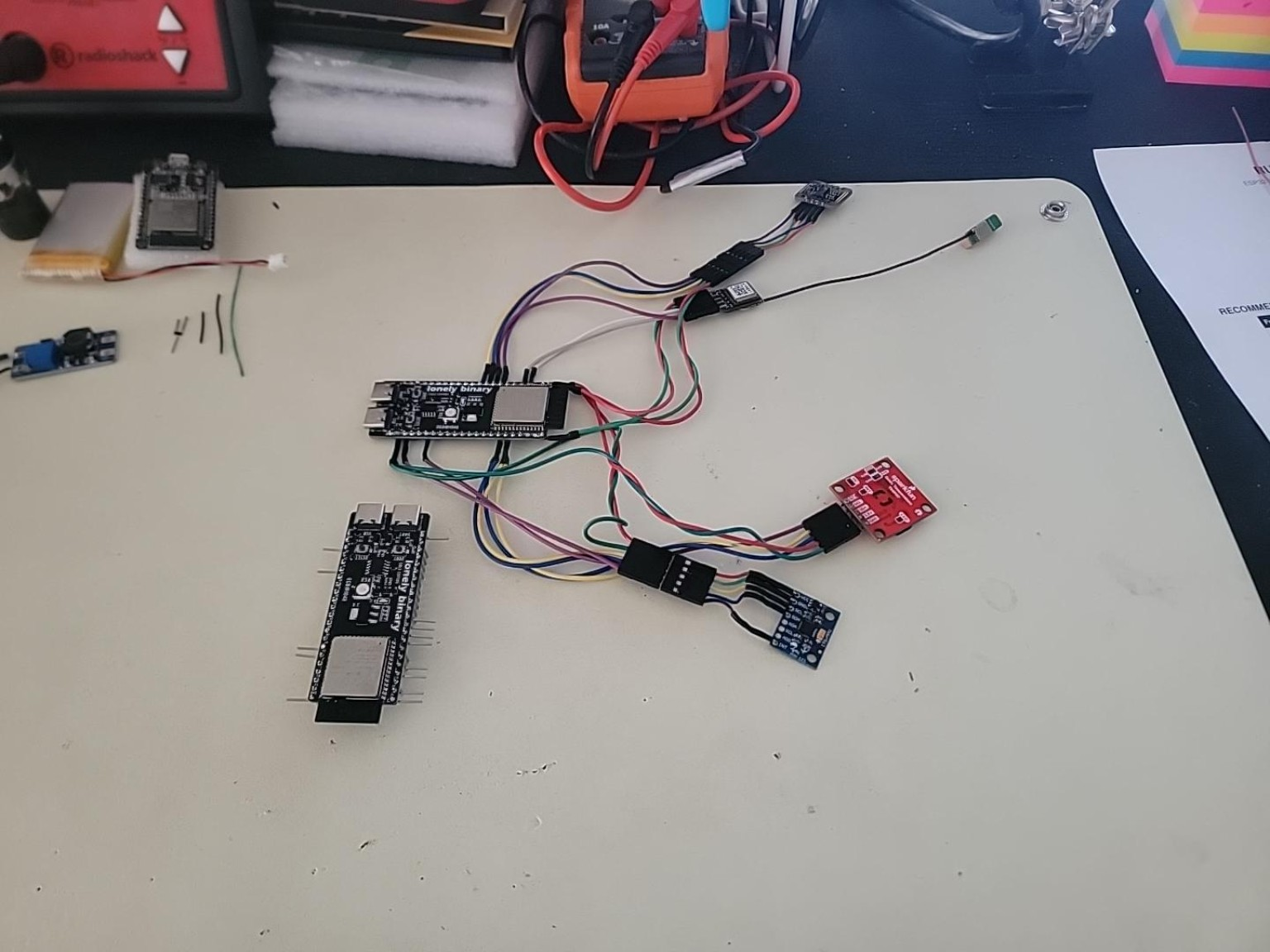
Cowbird Prime is the active Rūts development prototype. Its architecture combines independent physical, physiological, spatial, temporal, and device observations while maintaining local qualification before synthesis.
Optical evidence contributes an observation that the wearable is physically being worn.
Optical pulse observation contributes physiological liveness evidence.
Experimental SpO₂ observation remains under acquisition and qualification refinement and is non-diagnostic.
TMP117 observation contributes thermal evidence associated specifically with skin contact.
Independent motion observation contributes activity and resting-state context.
Satellite-derived geographic observation contributes independent location context.
GNSS pulse-per-second provides an independent timing observation.
Each Rūts device generates a hardware-derived device identifier.
Rūts does not treat every available sensor value as evidence. Independent observations must become available, observed, and qualified before they contribute to synthesis.
Trust Confidence represents how completely the current observation policy has been satisfied.
100% confidence means 100% of the observations required by the current qualification policy are presently qualified. It does not mean absolute truth.
Rūts is being developed so that an observation event exists because independent evidence satisfied the current qualification policy—not merely because another interval of time passed.
Cowbird continuously observes its available evidence sources. When the required observations become qualified, confidence reaches the current qualification condition and the system can produce a qualified observation event.
Computationally expensive derived observations are being developed so they do not unnecessarily block the protected acquisition paths producing the observations underneath them.
Motion and optical observations are also being developed to cooperate rather than treating movement automatically as failed liveness.
Observation should not disappear because connectivity does. Rūts is being developed to preserve qualified observations locally and forward them when the evidence path becomes available.
If connectivity is unavailable, qualified observations are intended to remain locally queued until a transmission path becomes available again.
Useful for the companion application's real-time interface. Temporary telemetry may be missed without becoming a missing evidence record.
Persistent, sequenced, locally retained, and intended to receive acknowledgement through the evidence pipeline.
Rūts transmits evidence because an observation qualified, not merely because a timer expired.
Rūts is not being developed to collect everything it can about a person and turn that activity into a corporate data product. Its purpose is different: observe defined evidence, qualify what matters, preserve what earned qualification, and give that evidence back to the person whose activity produced it.
Rūts is not being developed as a continuous remote person-tracking service. Location is one independent observation domain that can contribute geographic context to qualified evidence.
Rūts does not photograph, record video, or listen to conversations. Its observation domains are intentionally limited to evidence relevant to the developing liveness and Proofolio architecture.
Qualified observations are being developed around user-controlled ownership and access. Rūts evidence belongs to the person whose activity produced it.
Access beyond the user is intended to occur through deliberate, authorized sharing. Preserving qualified evidence does not make that evidence an IIC surveillance feed.
Rūts is here to give you something — not take everything.
Your Rūts. Your evidence. Your decision to share it.
Cowbird communicates its observation state through BLE to the Rūts companion application, providing a human-facing view into locally observed evidence and device state.
The application is being developed as part of the broader Rūts evidence environment rather than as a separate source of truth. Cowbird performs observation and local qualification first; the companion application presents that state for human review.
Mobile integration remains under active development.
The interface does not create the evidence. It provides access to evidence produced by the observing system.
Rūts is ultimately being developed around Proofolio, not around becoming another fitness tracker.
A Proofolio is a growing body of locally observed evidence that can accompany projects, work, experiences, field activity, and other real-world accomplishments.
The wearable does not need to decide what those accomplishments mean. It contributes observational context that another application, project record, or evidence system can use.
Proofolio is being developed around qualified observations rather than raw telemetry. The objective is not to preserve everything a sensor produced, but to preserve evidence that earned qualification.
Rūts determines what local observations qualify. Those qualified observations are being developed to enter a broader evidence path without requiring the wearable itself to perform every transport, routing, preservation, or downstream interpretation role.
The architecture is currently being activated and tested. The full production evidence pipeline is not presented as completed capability.
Determines what local observations qualify.
Synthesizes local evidence and confidence and governs qualification behavior.
Moves qualified observations without becoming the authority that decides whether they qualified.
Accepts, validates, sequences or deduplicates, and routes observations through the developing evidence environment.
Preserves observation lineage and evidence continuity.
Uses preserved evidence as context around projects, work, experiences, and accomplishments.
AI detectors attempt to analyze an artifact afterward and infer whether AI produced it.
Rūts explores a different approach: contributing evidence that a human physically participated in the process surrounding creation while the activity was happening.
AI can still be part of the workflow. Rūts is not designed to prohibit AI or compete with it. The objective is to preserve qualified observational context surrounding human participation, not to claim that an artifact was or was not AI-generated.
Augment. Never replace.
Cowbird Prime intentionally began with a demanding continuous-observation workload. With simultaneous observation capability established, current research is shifting toward reducing the energy required to preserve useful evidence.
Observation rates can be investigated against changing conditions rather than assuming every domain must always operate at maximum activity.
Heart-rate and experimental SpO₂ work continues to examine how useful optical observations can be qualified without unnecessary acquisition or computation.
Qualified evidence and live telemetry are being separated so redundant transmission does not become a requirement for evidence continuity.
GPS observation and duty-cycle behavior remain areas of investigation as Rūts moves toward more power-conscious operation.
CPU and power-state behavior are being examined against the computational cost of acquiring, qualifying, and preserving observations.
Development increasingly asks not only whether an observation can be produced, but whether the evidence it contributes justifies the energy required to produce it.
Cowbird Prime has progressed from bench validation into extended endurance and daily-wear testing. Current development focuses on observation qualification, optical stability, power efficiency, evidence persistence, and full continuity-pipeline operation.
Continuous-operation testing now includes endurance runs exceeding 24 hours.
Cowbird is being worn during ordinary activity so development is informed by real movement, stillness, handling, and use.
Testing includes GPS loss and reacquisition rather than assuming continuous satellite availability.
PPS behavior is being observed through changing GNSS conditions and timing recovery.
Companion connectivity is being exercised alongside the continuous local observation workload.
Optical acquisition, sensor-bus architecture, and physical interconnects continue to be refined from observed prototype behavior.
The objective of this testing is not to turn prototype experience into exaggerated reliability claims. It is to discover what the next Rūts hardware must actually require.
Cowbird Prime is a development prototype, not the intended production enclosure or final circuit board.
Planning for custom Rūts hardware is beginning from requirements discovered through prototype testing rather than assumptions made before that testing occurred.
Current lessons include stable optical skin coupling, skin-specific thermal placement, protected optical acquisition, fewer interconnect failure points, power-conscious observation scheduling, and serviceable, testable hardware.
Rūts remains a product in development and is not a medical diagnostic device.
Heart activity, experimental SpO₂, and skin temperature are observation domains used within the developing liveness and evidence architecture. They are not presented as medical measurements, diagnoses, or clinical interpretations.
Demonstrate what works. Identify what does not. Let testing determine what comes next.